
In children's stationery manufacturing, many overseas brands face a frustrating gap between product concept and mass production: prototypes arrive with severe paper bleed-through, softened paint blocks, or missing chemical certifications that trigger customs holds at European ports.
Late last year, a Munich-based early childhood education brand approached TotoFish (Wenzhou Qide Cultural & Creative Co., Ltd.) with an urgent custom watercolor book project after enduring three months of failed sampling with two trading intermediaries.
The Client's Core Challenges
The client planned to launch a portable paint-with-water gift set for ages 3–6, designed for mess-free travel entertainment. However, their initial prototypes from previous suppliers suffered from three critical defects:
1. Severe Rear Bleed-Through
Previous suppliers used standard 180gsm offset paper. Whenever children applied excess water, pigment soaked straight through to the underlying page and stained tabletops.
2. Failed Sea-Transit Humidity Testing
Under simulated 40-day high-humidity container conditions, the solid watercolor blocks at the top of each page softened and adhered to facing sheets.
3. Missing Batch-Specific Compliance Docs
The prior vendors could not supply batch-specific EN71-3 heavy metal migration reports or valid MSDS sheets, blocking the product from entering German retail bookstore chains.
Totofish Engineering Diagnosis and Process Overhaul
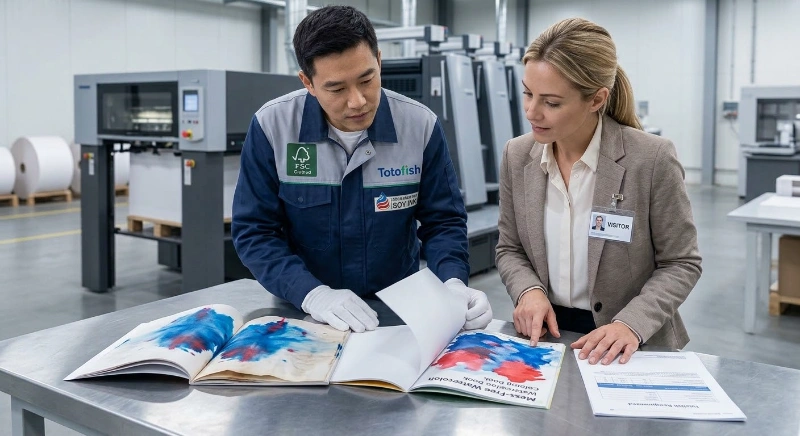
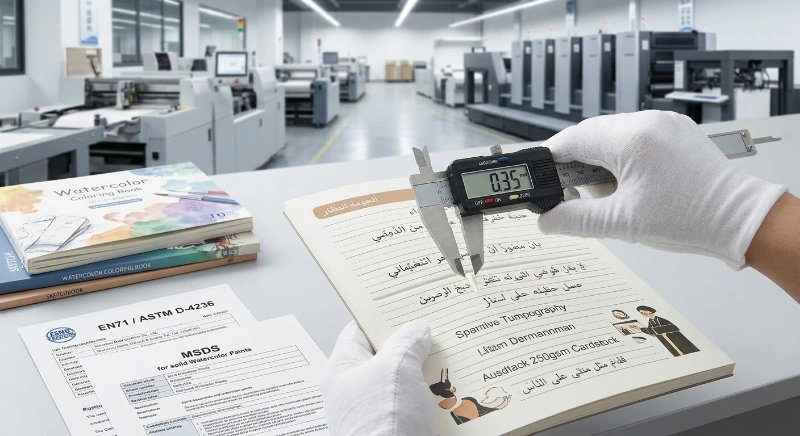
Upon receiving the failed samples, our engineering team conducted physical stress tests inside our 12,000 sqm facility and implemented three structural upgrades.
1. Improving Water Resistance and Preventing Bleed-Through
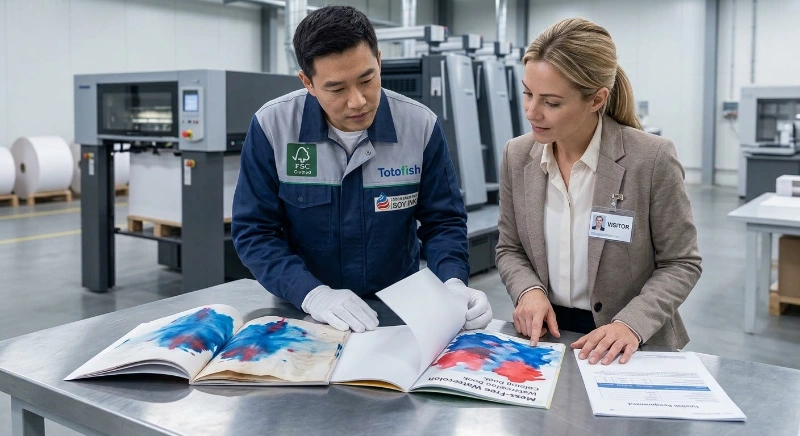
To eliminate bleed-through without making the book overly bulky, we replaced standard paper with heavyweight stock treated with a food-grade polymer barrier coating on the reverse side. Printed on our Heidelberg 5-color offset presses using 100% food-grade soy-based inks, the pages block water penetration completely even under heavy brushing. This exact barrier engineering is built into our standard mess-free watercolor coloring books line.
2. Preventing Paint Softening During Ocean Freight
To solve the ocean freight softening issue, we routed the printed sheets through a constant-temperature rapid-curing tunnel, locking pigment moisture below 3% and adding a microscopic water-soluble protective glaze over the paint pans.
3. Improving Page Handling and Product Usability
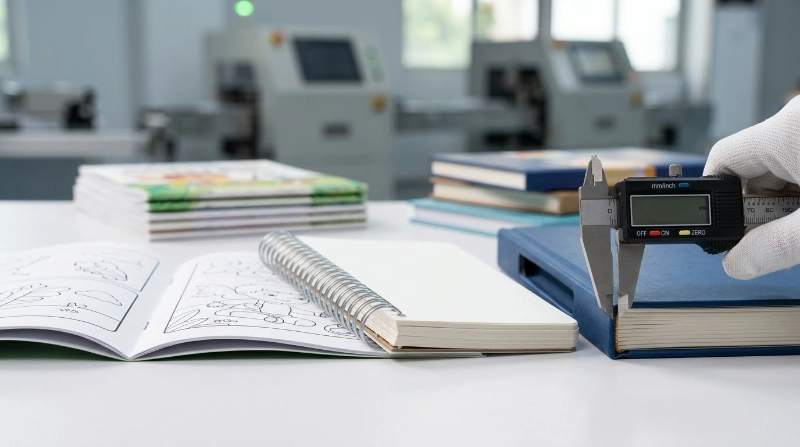
For structural usability, we replaced the rigid glue binding with rounded-edge Double Wire-O spiral binding paired with micro-perforated pages, allowing young children to flip pages 360 degrees on airplane trays and cleanly tear out finished artwork.
Lab Certification and 18-Day Mass Delivery
Once the revised prototype was approved, our in-house QA team coordinated third-party lab testing, securing full EN71-3, ASTM D-4236, and MSDS documentation within three days.
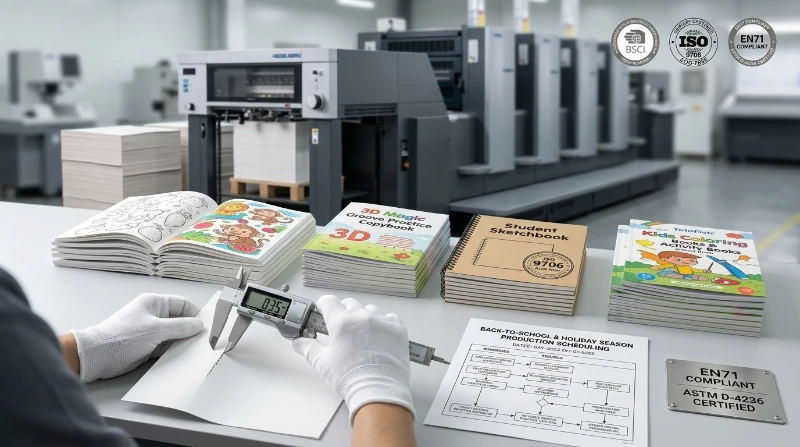
The initial mass production run of 50,000 units moved straight onto our automated Heidelberg lines. From final vector approval to container loading, total turnaround took just 18 days. The shipment cleared Hamburg customs smoothly, achieving a sub-0.2% retail return rate in its debut quarter.
Impressed by the engineering consistency, the brand has since consolidated its custom 3D magic groove copybooks and student sketchbooks manufacturing with Totofish.
Mitigate OEM Risks with Proven Factory Engineering
Successful private-label stationery requires more than basic printing—it demands proactive engineering to eliminate physical and regulatory risks before mass production begins. Backed by 15 years of export expertise and BSCI social audit certification, Totofish delivers dependable OEM/ODM execution.
Explore our automated production capabilities on the Totofish Factory Strength Page, or contact our engineering team today to submit your target samples for a complimentary technical evaluation!




 Totofish-Thea
 Totofish-Thea