Throughout our OEM/ODM partnerships with 100+ global educational brands, publishers, and e-commerce leaders, purchasing teams consistently scrutinize a core set of physical engineering metrics and chemical compliance mandates.
To accelerate pre-sourcing feasibility assessments for international partners, the Chief Manufacturing Engineer at TotoFish (Wenzhou Qide Cultural & Creative Co., Ltd.) addresses six high-frequency technical inquiries using live operational data from our 12,000 sqm facility.
Q1: What is the optimal groove depth for 3D practice copybooks, and how do variations impact usability?
Chief Engineer's Response:
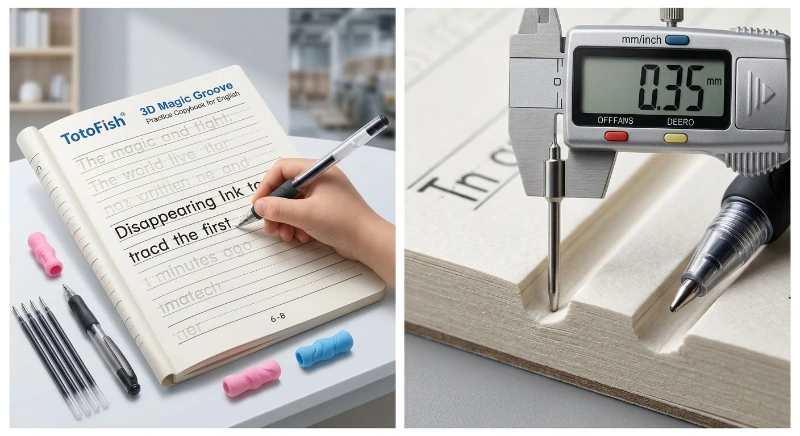
In our CNC thermal press unit, we lock indentation depth precisely at a 0.35mm golden standard.
Depth < 0.25mm: Provides insufficient physical tracking, causing the pen tip to slip out of the groove and failing to build proper stroke muscle memory.
Depth > 0.45mm: Over-stretches paper fibers, causing rear-side bulging, paper tearing, and pen tip snagging.
Furthermore, we combine this with 250gsm–300gsm virgin white cardstock to ensure grooves resist collapse even after 1,000+ writing cycles. Review complete tooling specs on our 3D Magic Groove Copybooks Catalog.
Q2: Do the pigment blocks in mess-free watercolor books melt during long sea transit? How is bleed-through prevented?
Chief Engineer's Response:
This is a frequent pain point in international paper sourcing. Our mess-free watercolor coloring books incorporate two protective engineering solutions:
Solid Thermal Fast-Drying Tech: Solid paint blocks are heat-cured post-printing to lock moisture below 3%. Pigments will not soften or adhere to facing pages during 45-day high-humidity ocean transit. Complete MSDS safety documentation accompanies every lot.
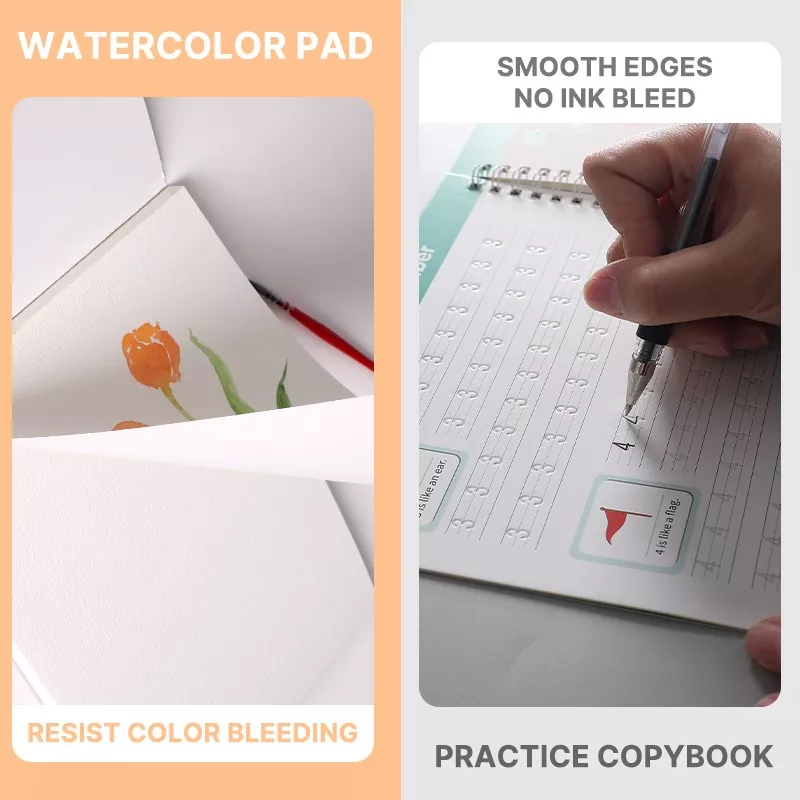
Polymer Barrier Coating: We apply a leak-proof barrier coating to the reverse side of our heavyweight stock. Water penetration is zero, preventing messy bleed-through onto tables or clothing.
Q3: For Amazon FBA sellers, how can we balance user experience with FBA dimensional tier fees?
Chief Engineer's Response:
Amazon FBA fees scale strictly with carton volume and package thickness. We recommend utilizing Saddle Stitching (Staple Binding) for lightweight lines:
Square Back Pressure: Our automated saddle stitching lines apply secondary spine pressing, reducing 10-pack bundle thickness by over 20% to help sellers qualify for lower FBA dimensional tiers.
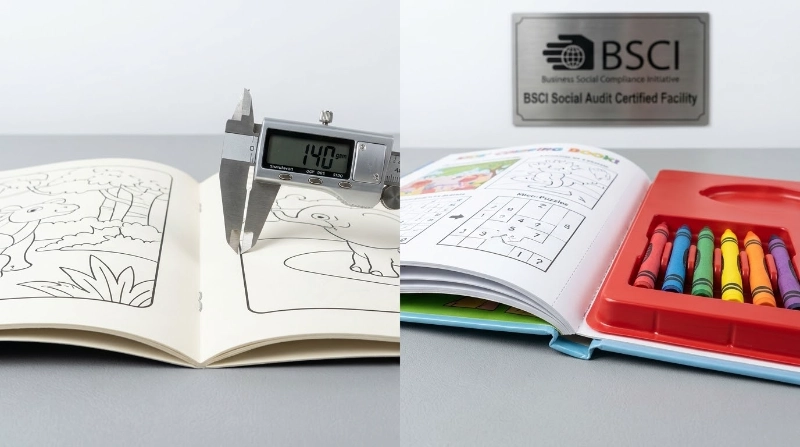
Product Alignment: Applying saddle stitching to our lightweight kids coloring books line reduces initial sea freight while guaranteeing full 180° flat-lay page opening.
Q4: What paper specification prevents marker bleed and yellowing on student sketchbooks?
Chief Engineer's Response:
The solution lies in paper density and acid-free archival certification.
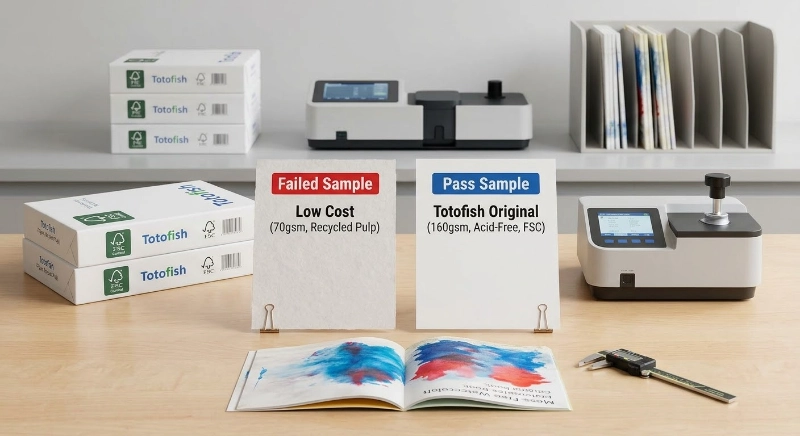
Standard 70–80gsm practice paper tears easily when saturated with water or alcohol ink. Our student sketchbooks rely exclusively on 160gsm virgin wood pulp paper certified to ISO 9706 Acid-Free standards.
Acid-free paper neutralizes ambient degradation, ensuring student artwork remains true to color without turning yellow or brittle over decades.
Q5: Do soy-based inks match the color saturation of traditional petroleum-based inks?
Chief Engineer's Response:
Yes, completely. High-purity soy oil carriers offer superior pigment dispersion and wetting characteristics.
Utilizing our Heidelberg 5-color Speedmaster offset presses with automated color calibration, our soy-based inks achieve vibrant spot-color matching with near-zero VOC (Volatile Organic Compound) emissions. Finished books are completely odor-free and fully certified under EN71-3 and ASTM D-4236 safety protocols.
Q6: What is the exact lead time from vector artwork approval to container loading for OEM orders?
Chief Engineer's Response:
Totofish executes a standardized 6-step manufacturing workflow:
Artwork Audit & Prototyping: 3–5 days for digital sampling and structural creasing.
Lab Certification & Queueing: 3 days for pre-press physical and chemical validation.
Mass Printing & Automated Binding: 15–20 days for total mass production and palletized packaging.
We use cookies to offer you a better browsing experience, analyze site traffic and personalize content. By using this site, you agree to our use of cookies. Privacy Policy






 Totofish-Thea
 Totofish-Thea